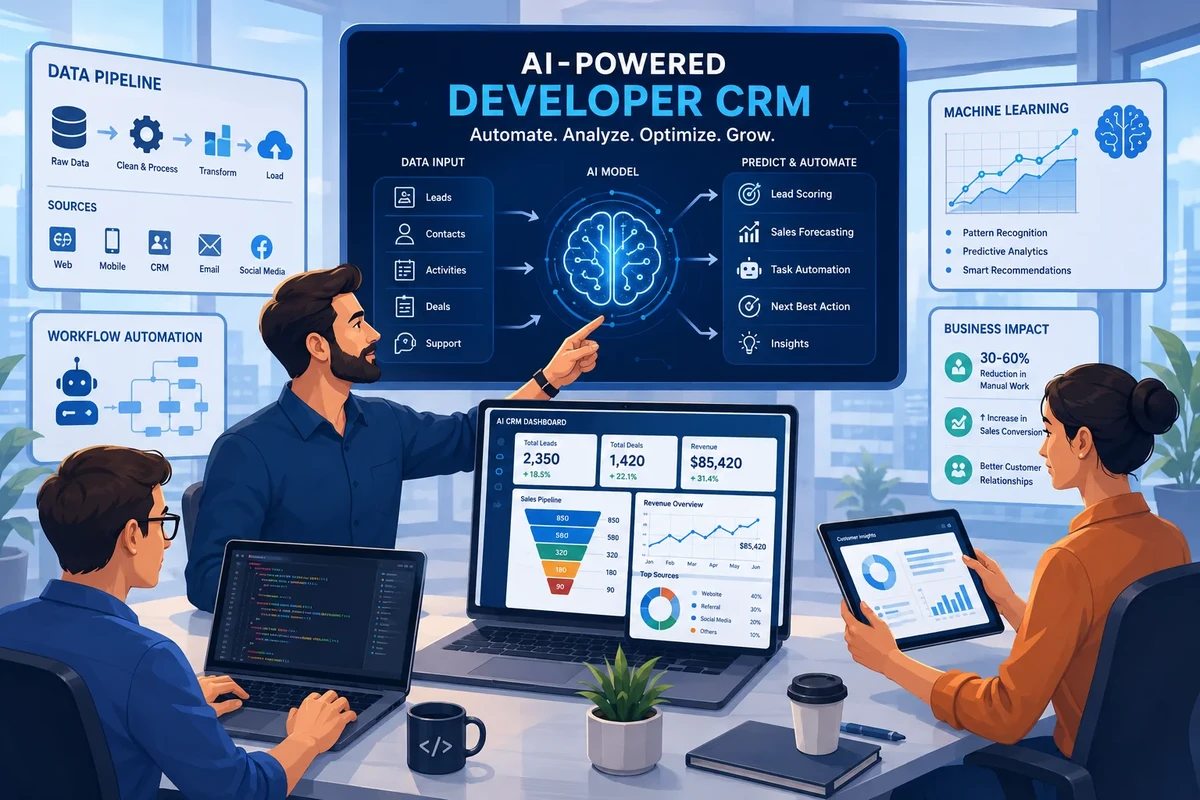
In 2026, AI-powered CRM platforms evolve from passive databases and reactive drafting assistants into interconnected multi-agent systems that autonomously execute revenue workflows across the pipeline. Gartner projects that 40% of enterprise applications will embed task-specific AI agents by the end of 2026, so CRM platforms can independently qualify leads, update deal stages from verified interaction evidence, and coordinate account retention workflows.
The Shift to Agentic Multi-Agent CRM Systems in 2026
The shift in enterprise CRM centers on autonomous execution through specialized agent networks that work across departments without manual handoffs. By the end of 2026, Gartner projects that 40% of enterprise applications will incorporate task-specific AI agents, climbing from less than 5% in 2025. This adoption reflects executive priorities: 86% of C-level leaders state that AI agents are important to their strategic goals over the next two to three years. As Burley Kawasaki, Global VP of Product Marketing and Strategy at Creatio, noted:
“Agentic automation is not simply another technology trend. It is the foundation of how enterprises will innovate, compete, and grow in the AI Economy.”
Forrester projects this architecture replacing isolated copilots with multi-agent networks that share operational context between sales, marketing, and customer service. While early copilots assisted individual rep tasks under direct human oversight, coordinated agents execute multi-step revenue operations directly. Revenue operations teams now judge these systems by measurable business returns instead of feature novelty. Data from McKinsey indicates AI implementations can reduce operational costs by up to 60% when applied across core revenue functions.
To maintain control as autonomous systems run background tasks, enterprise CRM platforms integrate specific governance interfaces directly into day-to-day screens. Transparency dashboards show why an agent triggered an action, the data records it evaluated, and the confidence score behind each outcome. Collaboration cues display visual indicators showing whether an update came from an agent, a sales representative, or both working together. When an automated action falls outside normal operating ranges, override controls give sales leaders single-click buttons to accept, edit, or reject the agent’s work immediately.
Autonomous Inbound Qualification and Outbound Prospecting
Autonomous agents qualify inbound leads and run outbound prospecting by executing research, data enrichment, and multi-channel outreach without manual rep involvement. Deploying AI across top-of-funnel operations delivers lead volume increases of more than 50% without adding headcount, running tasks at model usage costs between $0.002 and $0.05 per task (checked in November 2026).
Top-of-funnel automation in 2026 operates through four distinct workflows that eliminate routine rep tasks:
- Inbound enrichment and instant routing: When a prospect submits a web form, the CRM captures the submission, queries third-party APIs to fill missing firmographic details, scores the record, and routes it to the assigned territory representative in seconds.
- Autonomous prospecting and outreach: Specialized sales agents, including Lexi in monday CRM and HubSpot Breeze, independently discover prospect accounts matching ideal customer profiles, evaluate intent signals, and conduct initial outreach across email, phone, and SMS.
- Predictive scoring and ranking: Machine learning models analyze behavioral signals alongside historical win-loss patterns to score inbound accounts, directing sales representative attention to deals with the highest probability of closing.
- Consistent follow-up cadences: Automated pipeline workflows execute every scheduled touchpoint without drop-off. While a diligent sales representative executes follow-up tasks roughly 8 out of 10 times, automated sequences hit 10 out of 10 follow-ups without manual reminders.
By handling discovery, data entry, and introductory contact autonomously, these systems keep pipeline stages moving while sales representatives focus their time on live conversations with qualified buyers.
Evidence-Based Deal Tracking and Predictive Revenue Forecasting
Mid-funnel execution in 2026 relies on objective interaction telemetry that advances deal stages, sets pricing boundaries, and updates revenue forecasts without manual rep logging. Systems like Kris AI CRM read recorded activity directly from calls, email threads, and calendar invites, moving opportunity milestones based on verifiable events. Replacing subjective rep probability guesses with data-driven pipeline health checks accelerates sales cycle speeds by 30% to 50%. Conversation intelligence engines, including Salesforce Einstein and monday CRM Deal Insights, transcribe meetings and highlight deal stagnation risks alongside recommended next actions.
A prospect agrees to an introductory technical evaluation. Kris AI CRM detects the completed calendar event and ingests the call recording, transcribing the discussion. Natural language models identify that the prospect confirmed budget authorization and security requirements. Without rep data entry, the system automatically shifts the opportunity from Discovery to Technical Validation and logs the transcript in the account timeline.
During contract discussions, the buyer requests an enterprise volume discount. A real-time pricing agent evaluates the account’s seat volume, product configuration, and target margin thresholds. Rather than letting the representative guess, the agent calculates a margin-guarded Price-to-Win threshold, giving a hard discount boundary tied to a two-year commitment. The representative offers the structured tier, protecting deal profitability.
Once the prospect sends back the signed proposal via email, the platform verifies the digital signature attachment. It instantly moves the deal stage to Closed-Won. Because the CRM bases pipeline status on verified milestones rather than rep optimism, the revenue model recalibrates the regional quarterly forecast in real time, giving finance leaders an audit-ready projection.
Post-Sale Churn Prevention and Automated Expansion
Post-sale CRM systems in 2026 protect revenue by monitoring live account health across multi-channel touchpoints to prevent cancellations and identify expansion timing. Instead of waiting for customers to submit cancellation notices, predictive analytics evaluate usage patterns, support ticket sentiment, and email frequency to spot churn risks before accounts degrade. Integrating automated service workflows cuts customer service call handle times by up to 70%, freeing customer success teams to focus on accounts requiring strategic intervention.
Retention workflows connect front-office customer data directly to back-office enterprise resource planning systems. When a new contract or renewal closes, coordinated agents initiate inventory reservation, account provisioning, and revenue recognition schedules without manual handoffs between teams. In commercial accounts with recurring orders, predictive replenishment models track historical consumption cadences. These tools calculate expected product depletion dates and automatically send SMS reorder prompts two to three days in advance, securing renewals before inventory lapses.
Current enterprise data indicates that AI deployment concentrates heavily in customer-facing functions, with 13% of adoption focused in marketing, 12% in customer service, and 7% in customer success workflows. Platforms like Zoho Zia show that feeding unified operational context across sales, support, and finance into an integrated AI engine produces more accurate retention predictions than isolated point tools. Revenue teams that connect transactional back-office data to post-sale interaction signals build an operational pipeline where customer retention runs as an automated, continuous process.