For enterprise organizations evaluating CRM platforms in 2026, Microsoft Dynamics 365 Sales is the primary recommendation for enterprises standardized on Microsoft 365 and Azure infrastructure seeking predictable seat economics, while Salesforce Sales Cloud remains the benchmark for complex, multi-cloud architectures requiring deep custom governance. Fast-scaling commercial teams should select HubSpot Smart CRM to maximize cross-departmental adoption and rapid deployment without excessive administrative overhead. Platforms in this guide are evaluated across native technical ecosystem integration, autonomous AI agent and workflow capabilities, licensing predictability and total seat costs, and data governance complexity. The decisive buying factor is long-term operational and architectural alignment with your revenue model rather than sheer feature volume.
Enterprise CRM Shortlist and Buying Priorities for 2026
Enterprise CRM platform selection in 2026 centers on architectural alignment with existing data systems and operating models rather than feature count. As Jens Bohse, co-founder and CEO of Baked With, stated, the decisive factor is which CRM fits your business model in the long term, rather than the scope of the feature list. Enterprise teams evaluating platforms must assess how tightly a system binds to current databases, identity providers, and revenue operations.
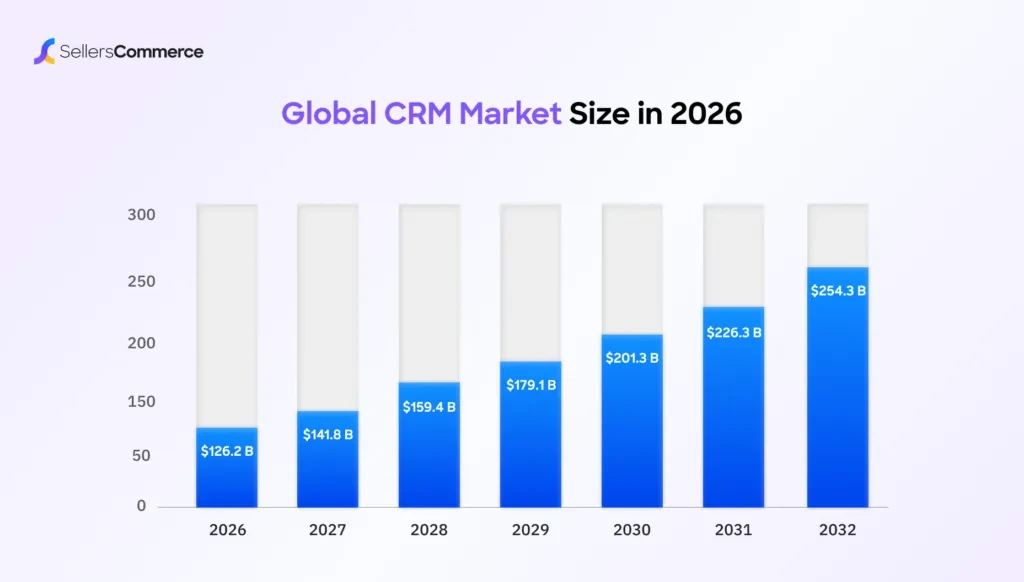
The enterprise CRM software market has expanded to a valuation of $330 billion in 2026. Operational expectations have changed with the introduction of autonomous agentic workflows. Instead of working as passive databases where sales reps log calls manually, modern platforms deploy agents that research accounts, draft communications, and update deal pipelines following voice-transcribed meetings. In platforms such as Salesforce and SAP, autonomous agent actions reduce manual sales data entry by up to 60%.
Deploying autonomous agents introduces specific technical liabilities. Security evaluations now require explicit AI governance reviews to establish strict boundary controls over the enterprise data that agents can read, analyze, and act upon. Sufia Parveen, researcher and author in ESP JETA, identified data quality, ethics, explainability, and accountability as primary challenges in AI-powered CRM systems. Without tight data access controls and defined execution boundaries, autonomous agents risk surfacing inaccurate recommendations or exposing sensitive commercial terms across unauthorized teams.
System integration capability serves as the technical dividing line between establishing a central system of record and creating disconnected operational silos. Enterprise buyers need native connectors spanning ERP, marketing automation, customer support, and central data warehouses. Implementation data shows that enterprise software rollouts rarely collapse because of missing software capabilities. As Matthew at Huble pointed out, most CRM migrations that go wrong fail on data and adoption, not features. Establishing clean data hygiene and structured permission models before contract execution prevents expensive post-launch remediation.
Comparison of Core Capabilities and Total Ownership Costs
Beyond base seat licensing, autonomous AI agent packaging causes the widest budget variations. While HubSpot offers Breeze Copilot on standard tiers with autonomous agents billed by usage, Salesforce prices its dedicated Agentforce 1 Sales tier at €550 (about $604) per user per month net, compared to €350 (about $384) per user per month for Sales Cloud Unlimited. Implementation cycles also drive upfront expenditure; deployments for 50 to 150 users on Salesforce and Microsoft Dynamics 365 benchmark between 12 and 26 weeks, demanding dedicated technical consulting and internal resource allocation.
Platform |
Enterprise Starting Price |
Primary Ecosystem Alignment |
Autonomous AI Packaging |
Typical Implementation Window |
Key Architectural Consideration |
|---|---|---|---|---|---|
Salesforce Sales Cloud |
$175 / user / month (annual billing) |
MuleSoft, Hyperforce, AppExchange |
Agentforce 1 Sales at €550 (about $604) / user / month |
12 to 26 weeks |
High administrative complexity and custom developer governance |
Microsoft Dynamics 365 Sales |
$105 / user / month (paid yearly) |
Microsoft 365, Teams, Azure, Power BI |
Embedded Copilot Studio capabilities |
12 to 26 weeks |
Complex multi-tier licensing and active data governance needs |
HubSpot Smart CRM |
$150 / seat / month (annual, 10-seat min, plus onboarding) |
Unified commercial GTM stacks and iPaaS integrations |
Breeze Copilot with usage-billed agents via Agent Hub |
Rapid deployment (under 12 weeks) |
Simpler administration, less suited for bespoke legacy transaction logic |
SAP Sales Cloud |
$134 / user / month (3 to 36 month contract) |
SAP S/4HANA, SAP ECC, SAP ecosystem |
Native SAP enterprise AI layer |
Enterprise rollout timeline |
Requires significant initial enterprise system configuration |
Platform Fit by Enterprise Architecture and Revenue Model
Architectural alignment and go-to-market structure dictate long-term CRM success. Enterprise procurement in 2026 maps directly to two technical vectors: core infrastructure alignment (Microsoft 365 and Azure, SAP core ERP, or heterogeneous multi-cloud environments) and revenue motions (matrixed global territory routing versus rapid commercial expansion). As Matthew at Huble documented, enterprise CRM AI has converged across HubSpot Breeze, Salesforce Agentforce, and Microsoft Copilot into three operational tiers: in-app task assistants, autonomous role agents, and automated pipeline data enrichment. Matching these tiers to existing data repositories prevents data duplication and spiraling administrative debt.
Salesforce Sales Cloud
Salesforce Sales Cloud starts at $175 per user per month (or 175 EUR (about $192) net) on annual billing for Enterprise edition, with Unlimited priced at €350 (about $384) per user per month net. The platform aligns with MuleSoft for enterprise integration pipelines, AppExchange for third-party extensions, and Hyperforce to store customer data within localized jurisdictional boundaries, including Germany. Salesforce best fits enterprises running heterogeneous multi-cloud stacks with complex matrixed territory routing and specialized sales motions. Technical teams use Salesforce Flows to automate intricate vertical deal assignments and multi-tier approval paths as organizations expand. In late 2024, Salesforce launched Agentforce, folding earlier Einstein capabilities into autonomous agents, with the specialized Agentforce 1 Sales tier priced at €550 (about $604) per user per month net. The main platform drawback is high administrative complexity; maintaining custom apex logic, validation rules, and extensive permission sets requires dedicated system administrators, alongside long deployment cycles of 12 to 26 weeks.
Microsoft Dynamics 365 Sales
Microsoft Dynamics 365 Sales Enterprise edition lists at $105 per user per month paid yearly (or 91 EUR (about $100) net), with Professional edition starting at $65 per user per month (or €56.30 (about $62) net) and Sales Premium at €130 (about $143) net. The platform aligns directly with the broader Microsoft environment, including Outlook, Teams, SharePoint, Excel, Power BI, Power Apps, Power Automate, and LinkedIn Sales Navigator, hosted securely across European and regional Azure data centers. Dynamics 365 best fits organizations already standardized on Microsoft corporate infrastructure seeking unified collaboration and business analytics. It integrates Microsoft Copilot Studio to embed assistant features and agent actions directly into everyday communication tools like Teams and Outlook. The main platform drawback lies in licensing complexity and administrative sensitivity; without strict data governance frameworks and clear operational process designs, the interface can feel heavy to end users and lead to data fragmentation. Typical enterprise rollouts for 50 to 150 users require 12 to 26 weeks.
HubSpot Smart CRM
HubSpot Sales Hub Enterprise starts at $150 per seat per month on annual billing (or 150 EUR (about $165) net), with a 10-seat minimum requirement and a mandatory €3,420 (about $3.8 thousand) onboarding fee (or $7,000 in specific enterprise packages). Professional edition starts at $90 per user per month. The platform aligns with unified commercial go-to-market operations and composable CRM architectures, connecting best-of-breed marketing, sales, and service tools through iPaaS connectors into a central data lake. HubSpot best suits fast-scaling commercial organizations prioritizing high sales rep adoption, low administrative overhead, and rapid pipeline execution using tools like the Pipeline Kanban for lead tagging. Its AI framework combines Breeze Copilot on standard tiers with autonomous agents managed through Agent Hub and billed by usage. The main platform drawback is architectural inflexibility for edge cases; it is less suited for companies that require deeply custom legacy transaction logic, multi-subsidiary enterprise billing rules, or bespoke code-heavy data structures.
SAP Sales Cloud
SAP Sales Cloud version 2 starts at $134 per user per month for contracts spanning between 3 and 36 months with automatic renewal. The platform integrates natively into the broader SAP application ecosystem, establishing direct real-time data flows between front-office sales actions and back-office enterprise resources. SAP Sales Cloud best fits global enterprises running core operations on SAP S/4HANA or SAP ECC that require immediate transactional synchronization between deal pipelines, supply chain fulfillment, and financial ledgers. Its AI layer comes with embedded pipeline health scoring, contextual sales guidance, and automated account data enrichment tied directly to enterprise ERP records. Its implementation footprint is the primary platform drawback; the software’s full scope requires significant initial system configuration before operational deployment, making it uneconomical for teams operating outside an established SAP enterprise footprint.
Selecting the right enterprise CRM requires balancing existing IT architecture against go-to-market execution speed. Choose Microsoft Dynamics 365 Sales when standardizing on Microsoft 365 and Azure to secure predictable seat pricing and native Teams workflows. Implement Salesforce Sales Cloud when managing complex matrixed sales territories and heterogeneous enterprise stacks that require MuleSoft and deep developer customization. Deploy HubSpot Smart CRM when building a composable commercial engine that prioritizes rapid user adoption and unified marketing-to-sales data. Choose SAP Sales Cloud when core business operations demand immediate, native synchronization with SAP S/4HANA or SAP ECC enterprise ledgers.
Conversions use a rate of 1 EUR = $1.10 as of November 21, 2026; rates may change.