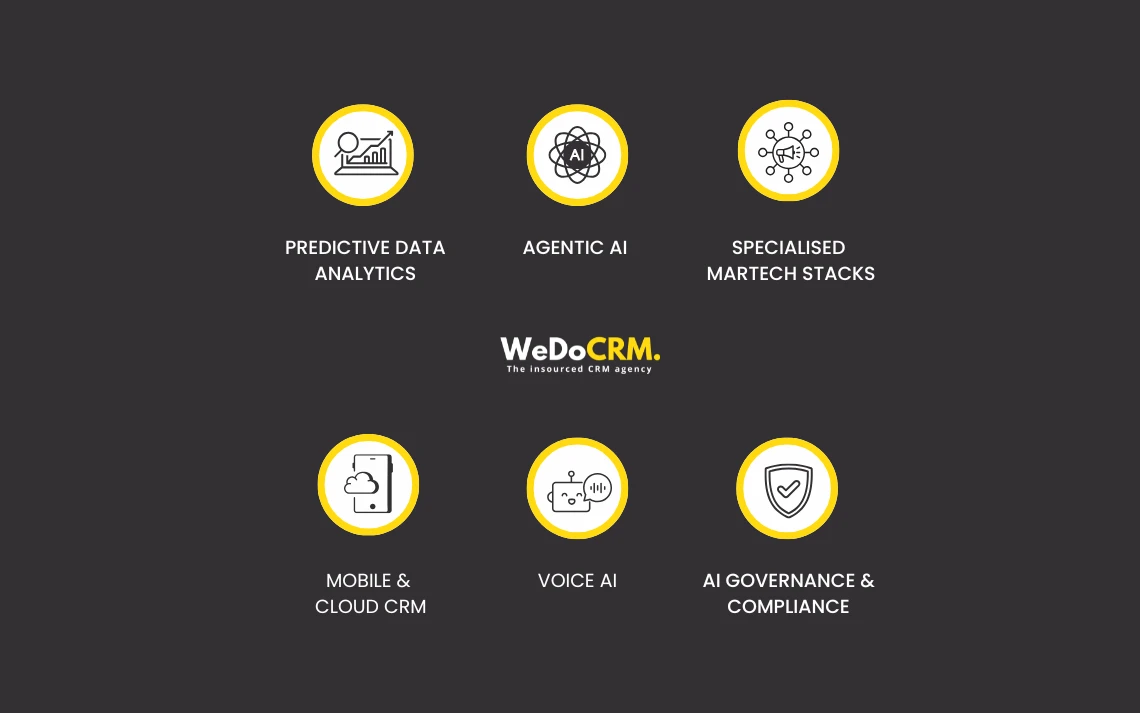
Autonomous Agentic Workflows suit enterprise sales organizations automating multi-step execution, while Composable iPaaS Integration Layers suit RevOps teams eliminating cross-departmental reporting silos. In 2026, enterprise CRM shifts decisively from a static system of record to an autonomous system of action, with software budgets reallocating capital away from high-volume outbound messaging toward unified customer data architectures, predictive behavioral intelligence, and outcome-based pricing models.
Where Enterprise CRM Architecture Is Heading in 2026
Enterprise CRM architecture in 2026 centers on autonomous systems of action that execute multi-step operational logic without manual rep intervention. Industry data shows that 90% of software buyers now prioritize native AI capabilities, while 67% of organizations run AI-enabled sales tools. Gartner projects that more than 80% of enterprises will deploy generative AI in production by 2026. As IDC analyst Neil Ward-Dutton observed: “Organizations that rethink CRM as a real-time, AI-powered system of action — and embrace agentic AI to handle complex, unpredictable work — are better positioned to deliver exceptional customer experiences. This approach not only enhances satisfaction and loyalty but also drives operational efficiency and business agility.”
Pricing structures mirror this architectural shift. Subscription models are moving away from fixed per-seat licensing toward variable usage fees, autonomous agent workload rates, and verified business outcome metrics. Concurrently, 57% of users classify their CRM as critical to daily operations. CFOs now rely directly on core CRM datasets for enterprise financial forecasting, turning data integrity from an internal sales operations concern into a board-level governance requirement.
CRM Capabilities Earning Increased Investment for 2026
Autonomous Agentic Workflows
Autonomous agentic workflows claim top investment priority by executing end-to-end operational tasks within pre-established guardrails. Platforms like Zoho CRM come with Zia Agent Studio to orchestrate custom multi-agent logic, while Microsoft Dynamics 365 Sales deploys the Sales Research Agent across Outlook, Teams, and Copilot. Microsoft also released Agent 365 on May 1, 2026, establishing a dedicated governance layer for autonomous operations. Gartner projects that 40% of enterprise applications will feature task-specific AI agents by late 2026. For pricing context, the Enterprise plan covering Business and AI Studio starts at 75 USD per user/month, billed annually (prices checked in November 2026).
Deployment requires strict qualification. Daniel Talavera of WeDoCRM frames this shift: “From “what should we send?” To “what should happen next, or should we act at all?”” Teams lacking standardized lead definitions and clean data models must skip autonomous agent rollouts. Running autonomous agents over unstandardized records causes automated errors to scale across customer communications.
Composable iPaaS Integration Layers
Composable integration platforms represent the second major investment tier, directly connecting customer data platforms, real-time event streams, and enterprise resource planning systems. Industry reports show that 45% of enterprise software purchases specifically target integration improvements. Forrester analyst Leggett notes that CRM platforms are actively converging with customer data platforms, real-time event streams, and external data feeds to form connected customer data networks. This structural convergence explains why industry analyst Datwani notes that “Everyone is battling for that data layer”.
This infrastructure serves as the primary benchmark in 2026 capital reallocation decisions. RevOps leaders should use two specific operational thresholds to decide when to reallocate budget from seat licenses to integration layers: technical silo delays and seller tool fragmentation. Salesforce’s 2026 State of Sales report, surveying more than 4,000 sales professionals, found that 51% of sales leaders with AI report technical silos delay or limit their AI initiatives, while sellers use an average of 8 tools to close deals.
When an organization crosses both thresholds—51% of initiatives delayed by silos and sellers managing 8 distinct tools—buying more CRM seats or point add-ons produces diminishing returns. Funding composable iPaaS layers at that point eliminates manual reconciliation across finance, sales, and service, creating the unified data foundation required for reliable agentic automation.
Embedded Shared Digital Workspaces
Embedded shared digital workspaces secure dedicated budget to align enterprise buyers and sellers inside active opportunity records. These workspaces embed interactive pricing tables, contract documentation, and mutual action plans directly into deal pipelines. Gartner predicts more than 80% of enterprise sales cycles will involve at least one shared digital workspace by late 2026.
These environments suit multi-stakeholder enterprise deals where sales teams must coordinate legal, procurement, and technical reviews. Sales organizations with short, transactional sales cycles should skip this capability entirely, as maintaining shared digital rooms on high-velocity deals introduces administrative friction without increasing win rates.
Legacy CRM Systems and Practices Being Phased Out in 2026
Monolithic All-in-One Suites
Monolithic all-in-one CRM suites requiring multi-year commitments and rigid seat licenses are being phased out in favor of modular deployments. Historical industry figures show enterprise implementations of monolithic suites suffer failure rates between 20% and 70%. A study by The Pedowitz Group and Ascend2 reveals an internal perception divide: 55% of leadership teams believe their CRM is deployed effectively, compared to only 27% of frontline reps.
As noted in a 4CRMs analysis, “Modular CRM ecosystems beat all-in-one platforms.” UK kitchen supplier Howdens demonstrated this transition by rolling out Creatio across 20 pilot depots in 12 weeks after facing an 18-month Salesforce rollout, lifting sales conversion from 32% to 38%. Organizations are replacing rigid vendor lock-in with composable, API-first architectures that allow individual software components to be swapped without rebuilding the primary database.
Static Rule-Based Workflow Triggers
Linear if-then workflow triggers are being decommissioned as sales operations adopt predictive behavioral intelligence. Traditional static rules fire outreach based solely on milestone changes, lacking the negative decision logic needed to halt cadences when buyers disengage. ActiveCampaign research highlights that 69% of consumers expect consistent interactions across departments, yet 72% report trusting companies less than a year earlier.
Predictive models analyze deal dynamics, historical engagement, and sentiment risks before human managers detect account hesitation. Retiring static outbound triggers prevents automated message spam from degrading buyer trust, reallocating operational resources toward intent-driven outreach.
Disconnected Point Solution Stacks
Organizations are phasing out disconnected point solution stacks and manual administrative tracking to curb productivity loss. With sellers forced across an average of 8 tools to close deals, tool sprawl creates severe context switching while fragmenting customer interaction histories across isolated departmental databases.
Sales operations teams are actively decommissioning standalone point tools that require manual rep data entry. When CRM systems exist purely to populate executive reporting dashboards without returning daily automation utility to frontline reps, user adoption collapses. Phasing out disjointed point software in favor of ambient data capture and unified workspaces restores data integrity and reduces software overhead across the sales organization.